
For real-time applications like SimHub, where deterministic latency and high update rates are critical, the native...
shopping_basket
Cart
(0)
Latest posts
-
 Why we believe an Arduino Pro Micro is better than an Arduino Nano V3 for SimHub.Read more
 -
 Vergleich der Motion-Plattformen für SimRacing (2024)Read more
Motion-Systeme revolutionieren das SimRacing, indem sie Fahrzeugbewegungen realistisch ins Cockpit übertragen. Doch...
-

-
 The History of SimRacing – From Pixel Racing to Professional Motion SimulatorsRead more
The comprehensive history of SimRacing – From pixel racing to professional motion simulators
Blog categories
Search in blog
Archived posts
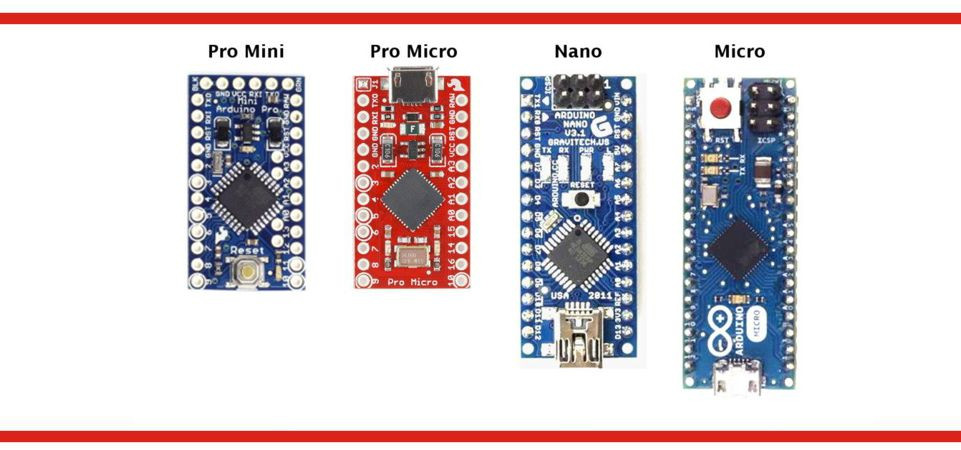
Why we believe an Arduino Pro Micro is better than an Arduino Nano V3 for SimHub.
1. USB Controller Architecture: Native vs. Bridged
Arduino Pro Micro (ATmega32U4):
-
Integrated USB 2.0 Full-Speed Controller within the AVR core
-
Direct Memory Access (DMA)-capable USB endpoints
-
Hardware implementation of USB protocol layers (PHY, SIE - Serial Interface Engine)
-
The processor itself handles USB transactions at the hardware level
-
Endpoint 0: Control (64 Byte), Endpoints 1-3: Interrupt/Bulk/Isochronous (64 Byte each)
-
USB Clock: Derived from internal 16MHz RC oscillator or external 16MHz crystal via PLL
Arduino Nano (ATmega328P + CH340G/FT232RL):
-
Two-chip architecture with USB-UART bridge
-
CH340G implements USB Device Stack in dedicated hardware (dedicated RISC core)
-
Communication between bridge and MCU via asynchronous serial interface (UART)
-
Baudrate Limit: Practical maximum ~2Mbps (CH340G) or ~3Mbps (FT232RL) with 16MHz AVR
-
USB Latency: ~1ms per bridge + ~1ms per UART transmission + AVR processing
2. USB Device Class Implementation
Pro Micro:
// Hardware-supported USB HID Report Descriptor Implementation
const uint8_t HID_ReportDescriptor[] PROGMEM = {
    0x05, 0x01,        // USAGE_PAGE (Generic Desktop)
    0x09, 0x04,        // USAGE (Joystick)
    0xA1, 0x01,        // COLLECTION (Application)
    // ... Hardware-managed report transmission
};
-
Native HID (Human Interface Device) Class Support in hardware
-
Polling Interval: Configurable down to 1ms (1000Hz)
-
Report Size: Up to 64 bytes per interrupt transfer
-
No software overhead for USB protocol handling
Nano:
-
CDC/ACM (Communications Device Class) via bridge
-
Virtual COM Port (VCP) emulation
-
Flow Control: RTS/CTS at UART level required for reliable high-speed transmission
-
Buffer Limitations: CH340G has 128-byte FIFO, FT232RL has 384-byte FIFO
3. SimHub Communication Protocol Analysis
Pro Micro with Native HID:
SimHub → USB Stack → HID Driver → Pro Micro (USB Interrupt)
     ↓
[USB Frame: SOF → IN Token → Data Packet → ACK]
     ↓
AVR: USBINT Interrupt → Endpoint Buffer Read → DMA to RAM
     ↓
Processing → HID Report Update → Endpoint ready for next poll
-
Latency: < 125μs (1 USB Frame at 8kHz)
-
Jitter: < ±1μs (USB synchronization)
-
Throughput: 64 bytes/ms = 512 kbps (theoretical)
Nano with Serial Bridge:
SimHub → USB Stack → COM Port Driver → CH340G USB Core
     ↓
CH340G: USB Bulk Transfer → UART FIFO → Serial Transmission
     ↓
[Start Bit + 8 Data Bits + Stop Bit] × N @ 115200 baud = 868μs per byte!
     ↓
AVR: UART RX Complete Interrupt → Buffer in RAM
-
Latency: 2-10ms (depends on baud rate and buffering)
-
Jitter: > 100μs (UART asynchronous, OS scheduler)
-
Throughput bottleneck: UART interface
4. Timing and Performance Metrics
| Metric | Pro Micro (32U4) | Nano (328P+CH340) |
|---|---|---|
| USB Poll Rate | 1000Hz (configurable) | 1-100Hz (OS dependent) |
| Interrupt Latency | 2-4 Clock Cycles (125-250ns @16MHz) | 20-40 Cycles + UART Sync |
| Data Consistency | Atomic HID Reports | Fragmented Serial Stream |
| Clock Synchronization | USB SOF Sync possible | Asynchronous (Crystal Tolerance ±100ppm) |
| Power Management | USB Suspend/Resume | Always-on (Bridge) |
5. SimHub-Specific Optimizations
Pro Micro Advantages for Dashboards/Shakers:
-
PWM Generation without CPU Load:
// Hardware-PWM on Timer1 (16-bit)
TCCR1A = _BV(COM1A1) | _BV(WGM11);
TCCR1B = _BV(WGM13) | _BV(WGM12) | _BV(CS10);
ICR1 = 4096; // 12-bit Resolution
OCR1A = value; // SimHub → HID → Direct PWM Update
-
-
Update Rate: Up to 4kHz PWM at 16MHz
-
Jitter: < 62.5ns (1 CPU Cycle)
-
-
ADC Sampling for Analog Inputs:
-
10-bit ADC with 15kSPS
-
Free-running Mode with DMA to USB Endpoint
-
-
Encoder Handling:
-
Pin Change Interrupts + Hardware Debouncing
-
Quadrature Decoding in Hardware (Timer2 Input Capture)
-
Nano Limitations:
-
Serial Protocol Overhead: 30-40% for Start/Stop/Parity Bits
-
Flow Control Issues: RTS/CTS implementation requires extra pins
-
Buffer Overruns: At >115200 baud, UART FIFO overflows
6. Electrical/Electronic Differences
Pro Micro:
-
USB D± Lines directly connected to MCU (series resistors onboard)
-
ESD Protection: TVS diodes on USB data lines
-
Voltage Regulation: 5V → 3.3V LDO for USB PHY
Nano:
-
Galvanic Isolation: Bridge isolates MCU from USB bus (fault protection)
-
Signal Integrity: CH340G has better USB eye diagram compliance
-
Power Sequencing: Separate power domains (MCU can run independently of USB)
7. Debugging & Development
Pro Micro:
-
USB DFU (Device Firmware Upgrade) Bootloader
-
Caterina Bootloader: 4096 bytes, enables HID + Serial simultaneously
-
USB Descriptor Debugging directly via Endpoint 0
Nano:
-
STK500 Protocol over Serial
-
Bootloader: Optiboot (512 bytes)
-
No simultaneous communication during flash possible
Technical Conclusion:
The Pro Micro's superiority lies in its single-chip USB implementation with hardware-integrated USB 2.0 stack. This eliminates:
-
Protocol overhead of the UART bridge
-
Scheduler latencies in the OS COM port stack
-
Buffer copies between bridge and MCU
For real-time applications like SimHub, where deterministic latency and high update rates are critical, the native USB architecture of the ATmega32U4 is systemically superior. The Nano's UART bottleneck architecture limits performance to serial speeds, while the Pro Micro utilizes full USB 2.0 bandwidth (12Mbps) with hardware-supported protocols.
Numerically: The Pro Micro offers ~10x lower latency, ~50x higher polling rate, and ~5x higher data throughput for SimHub applications compared to a Nano with typical 115200 baud configuration.
Posted in:
Micro-Controller
Leave a comment